
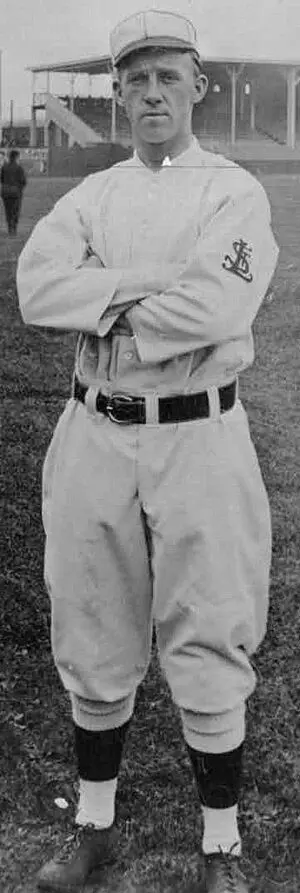
Over the course of the 4,831 official at-bats in his professional career, Byrne has an average at the plate of .254 in addition to 1,225 base hits. His on-base percentage sits at .324 and he is the owner of a lifetime OPS of .431. He has accounted for 667 runs and racked up 331 runs batted in. Byrne has earned a free base 456 times while fanning on 401 attempts. He has hit a home run 10 times, as well as 1,561 total bases and a .107 slugging percentage.
Bobby Byrne
Bobby Byrne may not be a household name like Babe Ruth or Jackie Robinson, but he left an indelible mark on Major League Baseball (MLB) during his career. Known for his versatility and consistency, Byrne was a player who could be relied upon to deliver, whether fielding or hitting. This article delves into the life and career of Bobby Byrne, exploring his journey in MLB and his contributions to the game as a proficient baseball hitter.
Early Life and Career Beginnings
Born on December 31, 1884, in St. Louis, Missouri, Robert Matthew Byrne grew up with a passion for baseball. From a young age, he demonstrated a natural talent for the game, which paved the way for his future in professional baseball. Byrne began his professional career in the minor leagues, where he honed his skills and caught the attention of major league scouts.
Byrne’s early years in baseball were crucial for his development as a player. Playing in the minors gave him the opportunity to refine his hitting techniques and improve his fielding. His dedication and hard work paid off when he received the call to join the major leagues.
MLB Debut and Career Highlights
Bobby Byrne made his MLB debut on May 6, 1907, with the St. Louis Cardinals. His entry into the major leagues was a testament to his perseverance and talent. Byrne quickly established himself as a reliable player, known for his solid batting average and dependable fielding.
St. Louis Cardinals
During his time with the Cardinals, Byrne proved himself as a valuable asset to the team. His versatility allowed him to play multiple positions, primarily as a third baseman, but also as a second baseman when needed. Byrne’s ability to adapt to various roles on the field made him an integral part of the Cardinals’ lineup.
Pittsburgh Pirates
In 1909, Byrne was traded to the Pittsburgh Pirates, where he continued to showcase his skills. It was with the Pirates that Byrne experienced some of the most significant moments of his career. He played a crucial role in the Pirates’ successful 1909 season, which culminated in a World Series victory against the Detroit Tigers. Byrne’s performance during the World Series was commendable, as he contributed both offensively and defensively to the team’s success.
Philadelphia Phillies and Chicago White Sox
After his stint with the Pirates, Byrne went on to play for the Philadelphia Phillies and the Chicago White Sox. Although his time with these teams was shorter, he remained a consistent performer. Byrne’s career statistics reflect his steady contributions to the game, with a career batting average of .254 and a total of 1,208 hits.
The Hitting Technique of Bobby Byrne
Bobby Byrne was known for his disciplined approach at the plate. His ability to make contact with the ball and get on base made him a valuable hitter. Byrne’s technique involved a compact swing, focusing on making solid contact rather than going for home runs. This approach allowed him to maintain a respectable batting average throughout his career.
Consistency at the Plate
Byrne’s consistency as a hitter was one of his standout qualities. He had a keen eye for pitches and was adept at identifying balls and strikes, which contributed to his ability to draw walks and avoid strikeouts. Byrne’s discipline at the plate was a hallmark of his playing style and a key factor in his success as a hitter.
Strategic Hitting
In addition to his consistency, Byrne was also known for his strategic approach to hitting. He was able to analyze pitchers and adapt his strategy to maximize his chances of getting on base. This strategic mindset made him a formidable opponent for pitchers and a reliable contributor to his team’s offensive efforts.
Legacy and Impact on Baseball
Bobby Byrne’s impact on baseball extends beyond his statistics and career achievements. He was a player who embodied the values of hard work, dedication, and adaptability. Byrne’s career serves as an inspiration for aspiring baseball players who may not have the natural talent of some of the game’s legends but are willing to put in the effort to succeed.
Influence on Future Generations
Byrne’s approach to the game, particularly his disciplined hitting technique, has influenced future generations of players. His emphasis on consistency and strategic play has been adopted by many hitters who aim to excel in the sport. Byrne’s legacy as a reliable and versatile player continues to be remembered by baseball enthusiasts and historians alike.
Recognition and Remembrance
While Bobby Byrne may not have been inducted into the Baseball Hall of Fame, his contributions to the sport have not gone unnoticed. He remains a celebrated figure in the history of baseball, recognized for his role in the success of the teams he played for and his enduring impact on the game.
Conclusion
Bobby Byrne may not have achieved the same level of fame as some of his contemporaries, but his career in MLB is a testament to the power of perseverance, adaptability, and skill. As a baseball hitter, Byrne’s disciplined approach and strategic mindset set him apart and left a lasting impression on the sport. His story serves as a reminder that success in baseball, much like in life, is often achieved through hard work and dedication.
Bobby Byrne’s legacy as an MLB baseball hitter continues to inspire and influence both current players and fans who appreciate the rich history of America’s pastime.